
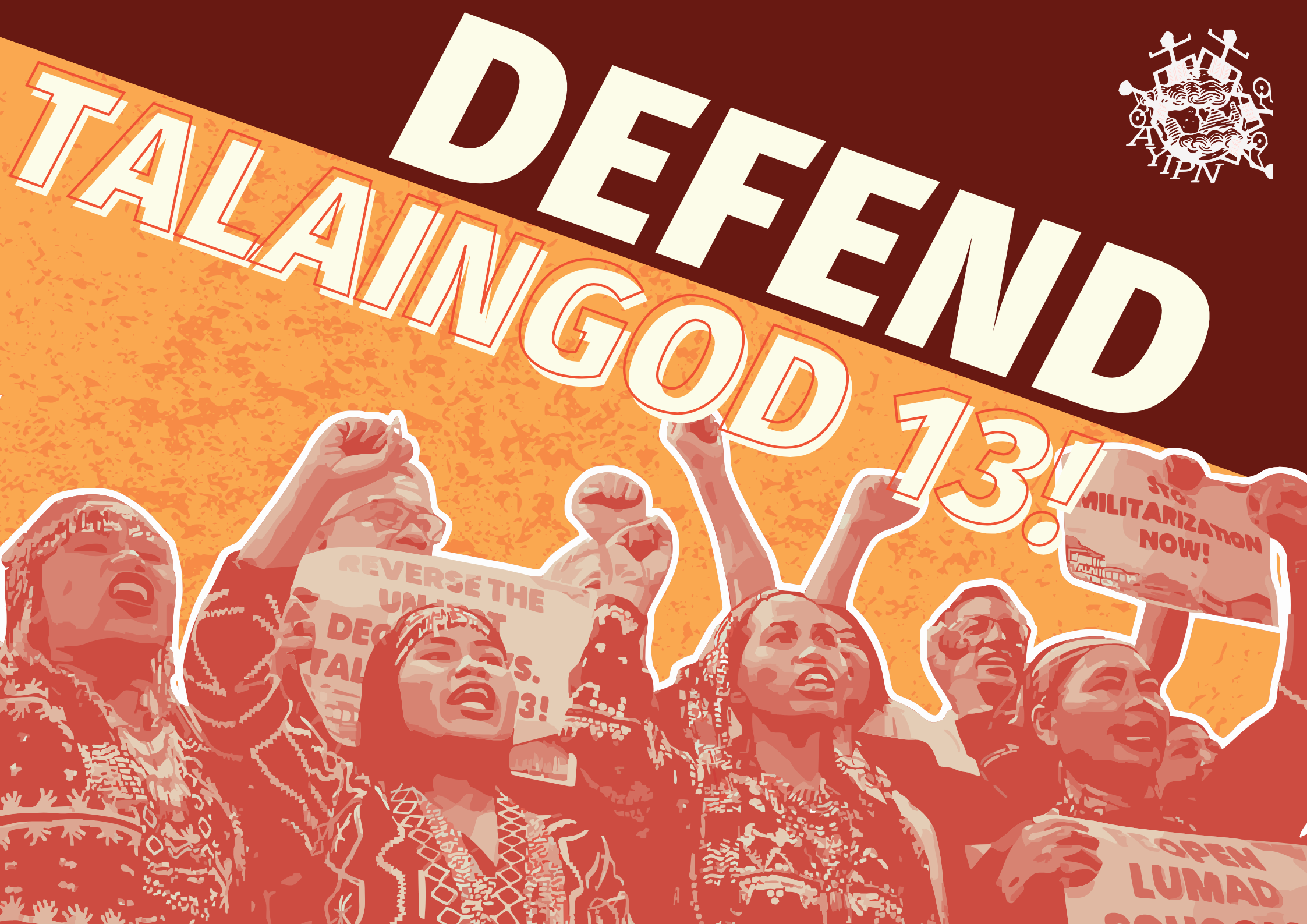
The Asia Young Indigenous People’s Network (AYIPN) stands in full solidarity with the call for the immediate reversal of the unjust conviction of the Talaingod 13.
On this anniversary of their conviction, we show commitment to fight for justice and condemn the unjust court decision against the 13 individuals (known as Talaingod 13) including ACT Teachers Partylist Rep. France Castro, former Bayan Muna Congress representative Satur Ocampo, members of Salugpungan Lumad schools and volunteer teachers who have been targeted for their advocacy for the Indigenous Peoples rights.
The Indigenous Lumad schools are an initiative of the Indigenous Peoples in Mindanao in the Philippines as means of exercising their right to education.
Although Lumad schools gained accreditation from the Department of Education in 2007, they have since endured growing harassment and forced closures, especially after former President Duterte’s 2017 claims that they were promoting rebellion, which led to intensified military attacks and red-tagging.
Amid intense attacks in November 2018, IP advocates and human rights defenders responded to calls for help by leading a national solidarity mission to rescue displaced Lumad students and teachers in the town of Talaingod, Davao Del Norte.
While in transit, their convoy was intercepted and blocked by members of the Infantry Battalion. Evacuees were subsequently detained, subjected to harassment, and threatened while in police custody.
By 2021, the forcible closure of over 200 Lumad schools has already displaced more than 10,000 students and hundreds of teachers.
Then by July 15, 2024 the Tagum City Regional Trial Court convicted 13 individuals of child endangerment.
The ongoing attacks on Lumad communities and Lumad schools under the Duterte government are part of a larger strategy to erase the self-determined educational systems that the IP and advocates have worked so hard to establish.
These schools are critical in preserving Indigenous culture and ensuring a future where the next generation is empowered to continue the struggle for their land and rights.
Under the Marcos Jr. administration, the state’s attacks on Indigenous communities and progressive organizations have not only continued Duterte’s campaign of terror but have escalated with militarization, surveillance, and political persecution.
Marcos Jr. has pushed for a significant increase in military spending for 2025 while essential social services, such as education, healthcare and agriculture, remain underfunded—exposing where the government’s true priorities lie.
The government’s continued implementation of Executive Order 70 through theNational Task Force to End Local Communist Armed Conflict (NTF-ELCAC) highlights this shift.
The NTF-ELCAC has also diverted resources to fake social services, such as the Enhanced Comprehensive Local Integration Program (E-CLIP).
This program claims to offer reintegration support for former rebels but has been used as a tool for red-tagging, coercion, and deception, manipulating impoverished communities into participating in government programs under duress.
The funds intended for genuine social services, like education, are instead weaponized to undermine real community efforts, further entrenching militarism and state repression.
Further deepening the focus on militarism, the Marcos administration has strengthened ties with foreign military powers, increasing military aid and joint exercises with countries like the United States.
This foreign assistance has been used to bolster the military’s capabilities, with little regard for the negative impact on Indigenous communities and the general population.
While the government pours more resources into defense, the basic welfare of its citizens—especially the most marginalized—is further neglected.
These actions represent a direct violation of international human rights law and the core principles of justice, as they prioritize militaristic repression over peace, education, and social welfare.
Education is a fundamental human right.
Yet, the youth and children of the Lumad communities face systemic barriers in accessing quality education, compounded by the government’s failure to provide basic social services to Indigenous communities.
Lumad schools play a crucial role in educating young people about the dangers posed by corporate exploitation of their land.
These lands, rich in resources such as minerals, forests, and water, are increasingly targeted by corporate companies seeking to exploit them for mining, logging, and large-scale agricultural projects.
These attacks are a direct curtailment of the rights of Indigenous Peoples to self-determination.
The struggle for the education of Indigenous youth is intrinsically linked to the broader fight for the recognition of our cultural, political, and territorial rights.
As fellow Indigenous youth, we call on all allies to stand with us in the fight for justice for the Talaingod 13.
We also call for the immediate stop of attacks on Lumad communities and Indigenous schools.
To show your support, we invite you to sign this online statement (Sign the statement now! Defend Talaingod 13! ) calling for justice for the Talaingod 13.
Let’s stand together for the Talaingod 13 and for all Indigenous Peoples. ##


